.avif)
TL;DR
Retailers are auditing their SaaS stacks because years of rapid adoption have left them with 15–30 overlapping tools, and agentic AI has amplified the problem. AI agents now perform tasks once handled by standalone SaaS products, while vendors simultaneously add AI features that overlap with other systems.
Audits routinely uncover 30–40% underutilized tools, frequent triple-payment for the same capability (e.g., multiple platforms sending emails or generating insights), and growing AI redundancy, where agents duplicate paid features.
Not just about cost-cutting, it’s about getting capability clarity. Retailers are deciding which functions still require dedicated systems and which can be handled by AI as vendor boundaries dissolve. The emerging preference: one platform doing three things well over three tools doing one thing perfectly.
Using a Kill / Keep / Consolidate / Automate framework, retailers are freeing up 15–25% of SaaS spend and building governance for a future where tools and AI increasingly overlap—so every system, feature, and agent has a clear purpose.
From “Buy a Tool” to “Make the Stack Work”
Retailers who once signed multi-year SaaS contracts without hesitation are now slowing renewals, scrutinizing invoices, and questioning every line item.
What used to be “buy a tool for every problem” is becoming “make the stack work as one system.”
Mid-market retailers, in particular, are running formal SaaS audits—not because of sudden budget cuts, but because of stack bloat. Many discover 15–30 tools spread across POS, marketing, analytics, operations, and finance. The uncomfortable truth: most teams can’t clearly explain what half of them do, who owns them, or how they connect.
What’s changing now is the intent.
Retailers are no longer asking, “What tool do we need next?” They’re asking, “What do we already have and does it still earn its place?”
As leadership teams push for clarity on usage, overlap, and integration paths, SaaS audits are becoming formal, repeatable processes. The priority has shifted from expansion to utilization: fewer tools, better connected, governed as a system rather than a collection of subscriptions.
Agentic AI Is Accelerating the Audit Imperative
SaaS audits were already becoming necessary. Agentic AI has made them unavoidable.
Retailers are increasingly deploying AI agents and AI “wrappers” that sit on top of existing SaaS tools—pulling data across systems, generating insights, executing workflows, and automating tasks that were previously handled by dedicated platforms. In many cases, these agents deliver outcomes faster and at lower cost than the tools they quietly replace.
This introduces a new and more complex form of overlap: SaaS tools and AI agents performing the same function in parallel, often without realizing it.
At the same time, SaaS vendors are embedding AI deeper into their products and using it to expand beyond their original scope. Features that once justified standalone tools ( basic analytics, segmentation, forecasting, workflow automation, etc) are increasingly bundled into adjacent platforms. What were once clearly defined categories are now blurring rapidly.
Examples of boundary-crossing across retail stacks include:
- CDPs adding campaign orchestration
- POS systems adding lightweight CRM and loyalty
- Workforce platforms adding task management and analytics
- Inventory tools adding forecasting engine
As a result, tools that were once complementary are becoming competitive and creating duplications in the existing stack.
This expansion creates three structural problems:
- Ambiguity in ownership : teams are unclear which system is responsible for which capability
- Functional overlap : similar AI-enabled features exist across multiple tools
- Questionable ROI : retailers pay for “new” features that quietly duplicate existing ones
And not to forget, AI agents themselves are absorbing entire categories of work. Agents can auto-generate reports (reducing reliance on BI-lite tools), pull and reconcile data across systems (lowering integration needs), draft customer communications (replacing parts of marketing automation), and execute workflows (reducing manual operations tools).
The result is a compounding overlap:
Tools overlap with tools, AI features overlap with tools, and AI agents overlap with both.
Retailers are now forced to ask a sharper question than before:
Are we paying recurring subscription fees for capabilities that AI already delivers more efficiently?
This is why modern SaaS audits are no longer about trimming licenses. They are about redefining the role of each system in an AI-augmented stack, before overlap turns into permanent inefficiency.
Why This Matters Now
After years of rapid adoption during the post-pandemic surge, retailers are entering a rationalization phase.
Multiple SaaS contracts are hitting renewal at the same time. CFOs are scrutinizing software the way they scrutinize inventory. The objective is not to slash budgets, but to understand actual usage and value.
The Goal is clear: leaner, more maintainable stacks heading into the 2026 renewal cycle.
AI Inflation Meets AI Redundancy
Retailers now face two simultaneous pressures:
- AI Inflation: Vendors are bundling AI features into higher tiers and raising prices—even when those capabilities are lightly used.
- AI Redundancy: Internal or third-party AI agents already perform many of the same tasks.
Without an audit, retailers risk paying twice for the same AI-driven capability, maintaining tools whose core value has been replaced by AI, and purchasing add-ons that duplicate what internal agents can already do.
This is the first time AI is reshaping the SaaS audit conversation.
What the Data is Showing
Once retailers begin auditing their stacks, the same patterns are beginning to appear repeatedly, regardless of geography, format, or scale.
Across mid-market and enterprise-lite retailers, audits consistently show that 30–40% of SaaS tools are underutilized. Usage gaps are driven by unused seats, overlapping functionality, and teams defaulting to spreadsheets or manual workarounds despite having paid systems in place. Over time, this creates 20–30% annual cost creep through auto-renewals, tier upgrades, and AI add-ons that quietly accumulate.
Several findings surface again and again:
- Duplicate capabilities
Loyalty features embedded in POS platforms coexist with standalone loyalty tools. CDP segmentation overlaps with marketing automation. BI dashboards compete with AI-generated insights. As a result, you may end up triple-paying for the same function. - Zombie subscriptions
Tools purchased during rapid expansion phases—often during COVID—are still being paid for, even though no one actively uses them. - Shadow IT
Store and regional teams buy tools on company cards without central visibility, introducing fragmentation and compliance risk. - Integration gaps
Systems that should connect don’t, forcing manual export–import workflows that negate the value of the software in the first place.
A recurring insight from audits is that most teams use 20% of the features in 80% of their software, yet pay for enterprise tiers designed for far more advanced use cases.
What’s new is the AI-induced redundancy which is now becoming the primary trigger for stack rationalization. Retailers aren’t just asking which tools are underused; they’re questioning whether some categories are still needed at all.
What This Signals for the Industry
Several structural shifts are underway:
1. ROI and usage are now mandatory
Seat-based pricing is under pressure. Retailers demand usage dashboards, modular pricing, and transparency—especially for AI features.
2. Vendor boundaries are dissolving
Loyalty enters CDP territory. POS enters BI. BI enters orchestration. Category blur increases duplication risk.
3. AI is forcing consolidation
Retailers increasingly prefer one strong platform plus an AI layer over five tools, five AI features, and five invoices.
4. The return of platform plays
“Good enough and integrated” is beating “best-in-class but scattered.” Vertical retail platforms are regaining momentum.
5. Procurement is evolving
IT and Finance collaborate earlier. Contracts move toward shorter terms and clearer exits. Audits become permanent governance, not one-time cleanups.
What Retailers Should Do Now
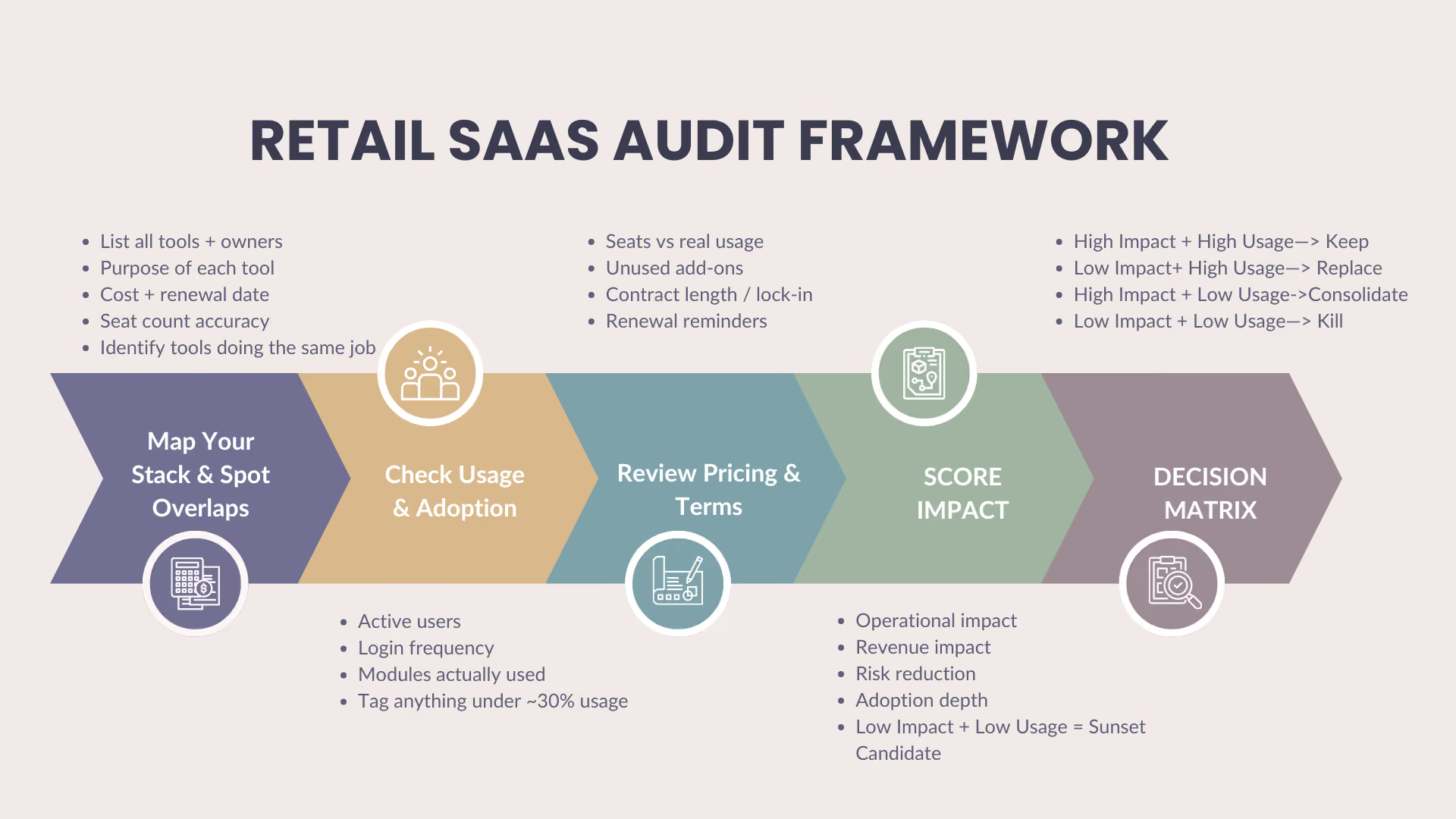
In an AI-augmented stack, SaaS audits must shift from cost review to capability governance. A practical approach comes down to four steps:
1. Get a single view of the stack, including AI
Pull every software contract across IT, marketing, operations, and finance. For each tool, identify the owner, core use case, active usage, renewal date, embedded AI features, and any AI agents performing similar tasks. Validate this with quick team interviews to surface real usage and hidden overlap.
2. Apply the Kill / Keep / Consolidate / Automate framework
- Kill: Low-usage (<20%) tools with no clear owner or unique value
- Keep: Systems that directly drive revenue, compliance, or core operations
- Consolidate: Standardize on fewer platforms where functionality overlaps, favoring integration over perfection
- Automate: Replace execution-heavy tools with AI agents where risk is low and ROI is clear
This is about choosing capabilities, not defending tools.
3. Renegotiate with leverage
Use usage data and AI overlap to downgrade tiers, remove unused seats, eliminate underused AI add-ons, and push for modular pricing and shorter terms—especially in fast-moving categories.
4. Make governance continuous
Maintain a live stack map. Review it quarterly. As AI expands across tools and agents, ongoing governance—not one-off cleanups—keeps complexity from creeping back in.
From SaaS Sprawl to Stack Discipline
SaaS sprawl is a phase. The retailers cleaning it up now are building a foundation for whatever comes next, AI layers, composable commerce, or the next wave of tooling.
The goal isn’t fewer tools. It’s ensuring every system, feature, and agent has a clear role in the stack.
We are in an Agentic era where AI is not just adding intelligence to the retail stack, it's reshaping the boundaries between tools. As a result, a SaaS audit is the inevitable infrastructure governance.
Retailers who master this discipline will operate with fewer blind spots, leaner stacks, faster decisions, and AI that works with their tools, not against them.

.avif)
.avif)