TL;DR
Returns have become one of retail’s biggest hidden margin drains, with processing costs reaching up to 65% of the sale value. As ecommerce grows, returns now touch every core system- OMS, WMS, POS, logistics, finance and these operational gaps directly impact NPS & recovery rates.
Modern retailers are shifting from basic OMS workflows to specialized returns platforms that deliver exchange-first flows, smarter routing, fraud controls, and SKU-level insights. The result: faster refunds, lower cost per return, and higher recovered value.
Your returns stack should unify CX, logistics, QC, and merchandising into one loop. Start with an audit, align on your strategy, shortlist based on the nine evaluation dimensions, and pilot before scaling. Returns aren’t going away—design a system that protects margin and strengthens retention.
The Hidden System That’s Quietly Bleeding Retail Margins
Returns were once simple: a customer walked in, handed over the item, you processed the refund, and moved on. That model collapsed the moment ecommerce scaled.
Online return rates now sit at 20–30% across most categories, with apparel pushing the upper limit. Retailers chase aggressive year-over-year growth while quietly absorbing the operational fallout—higher return volume, more complex routing, and a customer base that increasingly brackets sizes as standard behavior. What has changed isn't just volume. It is customer behavior. Wardrobing—ordering three sizes to keep one—is now standard shopper practice. And every day an item sits in returns purgatory (customer's trunk, carrier network, warehouse corner), its full-price recovery value drops.
In fact, the true cost of a return goes far beyond a refund: reverse shipping, QC labor, lost selling days, markdown exposure, and inventory distortion. Processing a single return can consume up to 65% of the sale value. That’s why returns have become one of the largest, least-acknowledged drains on retail P&Ls. Yet despite the rising stakes, many brands still rely on basic OMS workflows or manual quality assessment spreadsheets.
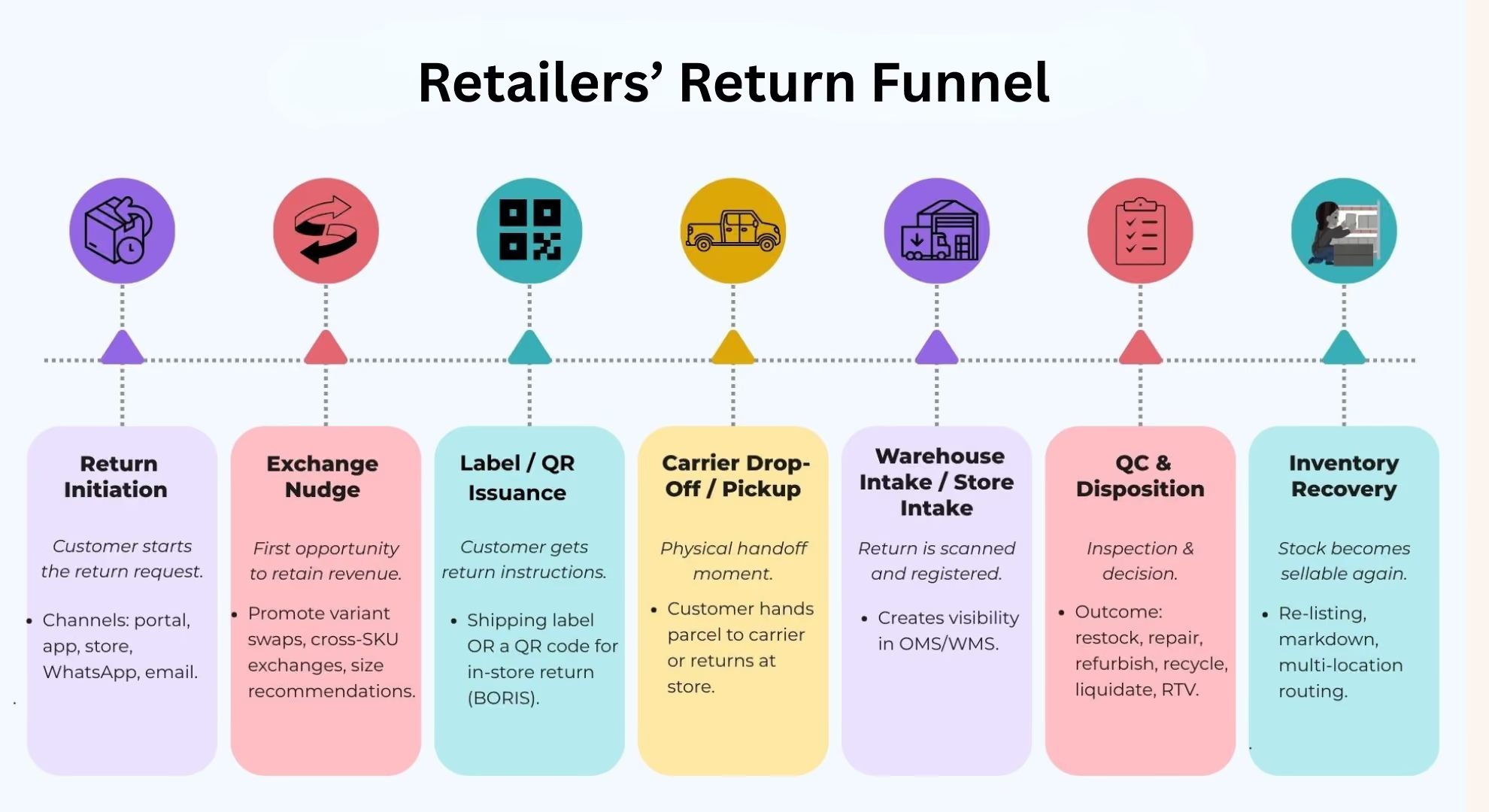
As brands scale across online, store pickup, and marketplace sales, returns complexity spikes. Returns now touch every system: OMS, WMS, POS, CRM, finance, and merchandising. When any link breaks, margin leaks. Inventory sits idle. SKU mismatches create write-offs. Refund delays hit NPS. Carrier costs spike without routing intelligence. Fraud patterns go undetected across channels.
Yet returns also present one of retail’s strongest under-utilized levers for revenue recovery. Exchanges protect the full sale. BORIS ( Buy Online, Return In Store) visits often convert into incremental purchases. Plus direct customer SKU level feedback is way more effective than any survey.
The real question is no longer how to process returns- it’s whether your current systems can capture this recovery opportunity, or whether they’re leaking margin at every step.
For mid-market retailers (10–150 stores with scaling online channels), the strategic decision is shifting: Do they continue handling returns inside our OMS/ERP, or adopt a purpose-built returns platform?
At stake is refund speed (customer retention), recovery rates (inventory salvage), operational overhead (team bandwidth), and hidden logistics costs (margin protection). That's why returns are no longer just an after-sales workflow, they're a strategic capability- one that influences CX, inventory accuracy, profitability, and loyalty.
The Core Building Blocks of a Modern Returns Stack
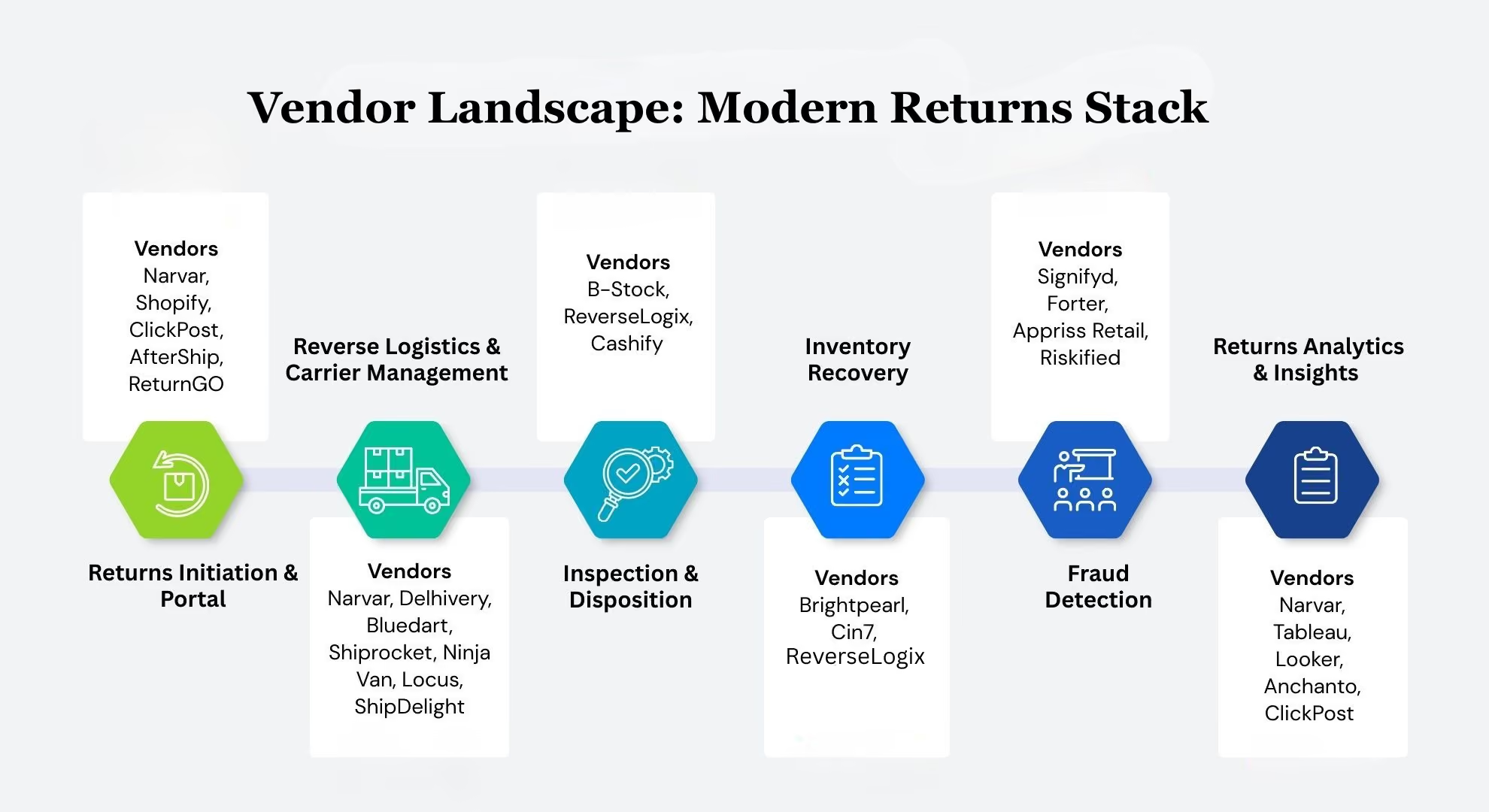
Returns aren’t a single workflow—they’re a six-layer system that spans customer experience, logistics, QC, and merchandising. Each layer either protects margin or leaks it. Here’s how modern retailers architect the stack.
1 Returns Initiation & Portal
Where the customer journey starts and often where revenue is saved.
The initiation experience shapes how customers perceive the entire return. Clean, intuitive flows reduce support tickets and strategically steer shoppers toward exchanges and store credit, not automatic refunds.
- What it does: Self-service return initiation on web or app, collects clear reason codes, generates labels or store-return QR codes, and promotes exchanges and store credit before refund.
- Dependencies: Ecommerce platform, OMS, carrier directory, and customer identity.
- Watch-outs: Cluttered forms that push customers to call support, vague or repetitive reason codes, inability to promote exchange-first options.
- Key Vendors: Narvar, Shopify, ClickPost, AfterShip, ReturnGO.
2. Reverse Logistics & Carrier Management
Where most hidden margin leakage actually occurs.
Once a return is triggered, this layer decides how the product travels back, how much it costs, and how visible the journey is to both customer and ops teams. Weak routing logic increases cost per return and delays restock cycles.
- What it does: Chooses least-cost carriers, consolidates multiple returns into one shipment, provides drop-off and pickup options, and surfaces transit status and exceptions.
- Dependencies: Carrier APIs, warehouse locations, and OMS sync.
- Watch-outs: Customers selecting higher-cost carriers by accident, parcels stuck in transit without alerts, and each item moving separately without consolidation.
- Key Vendors: Narvar, Delhivery, Blue Dart, Shiprocket, Ninja Van, Locus, ShipDelight.
3. Inspection & Disposition
The moment where value is either saved, downgraded, or lost entirely.
This is your QC engine. Consistent grading and disposition rules ensure sellable inventory doesn’t get written off and defective stock doesn’t sneak back into circulation.
- What it does: Scans items and grades condition, applies disposition rules (resell, refurbish, recycle, liquidate), captures QC photos and notes, and updates inventory systems immediately.
- Dependencies: WMS, barcode infrastructure, inventory systems, liquidation channels
- Watch-outs: Manual QC slowing restock by days, inconsistent grading across staff or locations, and sellable products getting mislabeled as damaged.
- Key Vendors: B-Stock, ReverseLogix, Cashify, Refit Global.
4. Inventory Recovery & Restock
The recovery engine that determines how much margin you get back.
Once QC is done, the speed at which items re-enter sellable stock directly affects markdown exposure and inventory accuracy.
- What it does: Automates restocking based on QC grade, routes items to optimal locations, updates real-time inventory across channels, and applies aging and markdown triggers.
- Dependencies: OMS, WMS, and inventory management system.
- Watch-outs: Items sitting in “returned” status for weeks, no inventory visibility across stores or distribution centres, and returned inventory not resurfacing in stock counts.
- Key Vendors: Brightpearl, Cin7, ReverseLogix, Optoro
5. Fraud Detection & Policy Enforcement
Protecting margin without damaging CX.
Returns abuse is rising across fashion, electronics, and marketplace-driven categories. The goal is to enforce policies consistently without punishing legitimate customers.
- What it does: Tracks per-customer return behavior, detects patterns such as wardrobing and repeat abuse, enforces return windows and fees, and maintains blocklists for high-risk profiles.
- Dependencies: Customer identity, order history, and returns data.
- Watch-outs: Overly aggressive rules blocking good customers, no escalation workflows for complex cases, and policies applied differently across channels.
- Key Vendors: Signifyd, Forter, Appriss Retail, Riskified.
6. Returns Analytics & Insights
The intelligence layer that converts returns into operational improvement.
Without analytics, returns stay reactive and expensive. With the right signals, retailers spot defects early, refine sizing/fit, optimize carriers, and understand true margin impact.
- What it does: Tracks return rate by product, SKU, and segment, measures time-to-restock and recovery value, calculates cost per return, and flags recurring return reasons so CX and merchandising can act.
- Dependencies: Returns platform, OMS, BI tools, data warehouse
- Watch-outs: Data locked inside a platform with no export, reason codes too broad to inform decisions, and no linkage between returns behavior and customer lifetime value.
- Key Vendors: Narvar, AfterShip, Anchanto, ClickPost, Loop Returns, Optoro, ZigZag, ReverseLogix
Three Architectural Paths
Retailers generally adopt one of three architectural models, each built around different levels of complexity, control, and automation. The right fit depends on return volume, unified commerce maturity, and operational capacity.
1. OMS/WMS–Native Returns Flows
The simplest model — and often “good enough” for early-stage or low-volume returns.
These platforms handle basics: generate labels, capture reasons, and sync refunds. For small catalogues or single-channel operators, or emerging D2C brands, “good enough” often holds.
- Strengths: Lower cost, one system of record, simpler adoption across stores
- Limitations: Weak exchange flows, no intelligence layer (instant refunds, fraud scoring, routing rules), and limited support for marketplace or cross-border returns
- Key Vendors: Shopify, Unicommerce, Vinculum, NetSuite, Zoho Inventory, Anchanto.
2. Dedicated Returns Platforms / Returns Automation SaaS
Purpose-built platforms that optimize the entire return → recovery loop.
Platforms in this category are built to solve the entire returns management process: From customer to carrier to warehouse to refunds.
- Strengths: Fully branded, high-conversion portals; exchange-first logic that protects revenue, dynamic rules for instant refunds, routing, and incentives, and SKU-level analytics that plug into merchandising.
- Limitations: Higher subscription cost, requires clean catalog, and tight OMS/WMS sync.
- Key Vendors: Narvar, ZigZag Global, ReturnGO, AfterShip, Loop Returns, Optoro, ReverseLogix
3. Logistics-Led Reverse Partners
Best when operational load must be offloaded or QC needs centralization.
These providers specialize in handling the physical movement of returns—the pickup, consolidation, transport, and in some cases, the QC itself. Ideal for retailers with distributed stores, limited ops teams, or categories requiring centralized inspection
- Strengths: Carrier orchestration, predictable RTO costs, faster consolidation for QC, and operational lift removed from store teams
- Limitations: Limited customer-facing experience, fewer levers for exchange uplift, QC and disposition rules often sit outside retailer control
- Key Vendors: Delhivery, Blue Dart, Shiprocket, Ninja Van, Locus
The Trade-Offs That Shape Your Decision
Returns management is a series of choices- each one shifting cost, speed, CX, and recovery value. Here’s where retailers & brands hit friction and why each trade-off matters.
1. Control vs. Convenience
OMS-native flows = simplicity and fewer integrations, but limited routing logic, weak exchanges, and no fraud intelligence. Dedicated platforms = automation and revenue retention, but require cleaner data and integration effort.
Why it matters: Simplicity scales early, but limits optimization as complexity grows.
2. Refund Speed vs. Fraud Risk
Instant refunds lift NPS: if supported by rules and return scoring. Risk patterns vary: fashion → wardrobing, electronics → remorse returns, home → damage claims.
Why it matters: Fast refunds without safeguards invite repeat abuse.
3. Exchanges vs. Refunds
Exchanges only work with real-time inventory checks across OMS/WMS. If availability can’t be confirmed instantly, the exchange collapses into a refund.
Why it matters: Every failed exchange is lost revenue and lower recovery value.
4. Customer Experience vs. Cost to Serve
Easy labels, fast refunds, and free pickups improve CX but inflate cost without routing intelligence. Smart retailers tier routing by SKU value (liquidation → refurbish/outlet → centralized QC).
Why it matters: Treating all returns the same pushes up cost per return and slows recovery.
5. Store-First vs. Centralized QC
Store-first improves speed and drives footfall but grading varies across locations.
Centralized QC ensures consistency but adds freight cost and delays.
Why it matters: Speed improves CX; consistency protects margin.
6. Modular vs. Bundled Architecture
Bundled OMS flows are quick to deploy but shallow in capability. Modular stacks (portal → logistics → QC → reCommerce) scale as volume and complexity increase.
Why it matters: Staying bundled for too long locks in inefficiency and caps recovery gains.
Guidance & Evaluation Framework
Evaluating a returns solution means understanding which systems actually reduce cost, protect margin, and improve customer experience at scale. Use this 9-point framework to score each vendor from 1 (basic) to 5 (advanced)—based on what truly impacts speed, accuracy, and recovery value.
1. Integration Depth
What to assess: Connectivity with OMS, WMS, POS, CRM, catalog, carriers, and payment gateways. BORIS readiness (QR codes, POS-synced intake, real-time refund + restock updates).
How to assess: Run a live end-to-end test: QR → POS → OMS → refund. Review API/webhook documentation and validate webhook reliability during a pilot.
2. Automation & Intelligence
What to assess: Approval rules, instant refunds, exchange incentives, fraud scoring, and disposition logic. Ability to route items to liquidators or skip warehouses when needed.
How to assess: Have vendors simulate high-risk, multi-line, and damaged-item scenarios with routing outcomes displayed in real time.
3. Customer Experience & Frontend Quality
What to assess: Branded portal, mobile-first UX, clear reason codes, communication flows, and drop-off/pickup instructions. Nudges toward exchanges.
How to assess: Walk through a mobile-first return. Evaluate clarity, friction, and how effectively exchange-first prompts are surfaced.
4. Exchange-First Capabilities
What to assess: Omnichannel exchange logic—variant swaps, cross-SKU exchanges, real-time availability checks.
How to assess: Test scenarios: variant swap, alternative product, out-of-stock fallback - without engineering involvement.
5. Logistics & Cost Optimization
What to assess: Carrier routing, consolidation rules, rate shopping, warehouse load balancing, and sustainable pathways. Carrier agnosticism is key.
How to assess: Review routing logic, compare carrier cost models, check peak-season performance, and test dynamic routing against your carriers.
6. Reporting & Insight Quality
What to assess: Depth of analytics—SKU return rates, reason-code clustering, defect detection, carrier performance, refund vs exchange metrics.
How to assess: Request dashboards + CSV exports. Validate how quickly defect signals surface (daily vs weekly vs monthly).
7. Inventory Recovery Speed
What to assess: Time from arrival → QC → restock. Real-time OMS/WMS updates, multi-location routing, aging rules, markdown triggers.
How to assess: Trace a sample batch of returns end-to-end. Review configurations for routing, aging, and markdowns. Compare recovered value vs write-offs over 3–6 months.
8. Fraud & Abuse Controls
What to assess: Repeat abuse detection, identity verification, wardrobing flags, return limits, and automated exception handling.
How to assess: Inspect rule configuration history, scoring thresholds, and examples of real abuse cases caught by the system.
9. Total Cost of Ownership (3 Years)
What to assess: Subscription fees, per-return charges, carrier pass-through, implementation effort, internal workload.
How to assess: Model 3-year return volumes with seasonality. Validate all itemized costs—labels, pickups, routing, integrations, additional store ops effort.
Buyer’s Checklist
Before shortlisting, get clear answers to these operator-grade questions:
- How does change management work once we go live?
- What can we configure ourselves vs. what requires vendor support?
- What happens when workflows break?
- How do you handle catalog updates and SKU proliferation?
- What does team enablement and training look like?
- How does the system scale with higher volumes or new channels?
- How do you stay ahead of compliance and policy changes?
- What does your roadmap prioritize over the next 12–18 months?
- What does exit look like—data export, workflow migration, portability?
Final Guidance & Scenario Fit
Your returns strategy should align with your business model, return volume, SKU complexity, and the operational variance your teams can absorb. Here’s how different types of retailers should approach their stack.
1. Digital-Native D2C Brands
(Low SKU Complexity · High Return Rates)
- Requirement: You need branded experience, exchange-first logic, and fast refunds without heavy ops overhead.
- Recommended Path: Dedicated Returns Platform with exchange optimization and instant credit workflows.
- Tools: Narvar, AfterShip, Return Prime, ReturnGO, PostCo
- Why It Matters: Clear ROI via improved repeat purchase rates. Focus heavily on the exchange flow to retain revenue. Use instant credit for recurring customers to lock in loyalty and avoid OMS-native limitations.
2. Omnichannel Retailers
(10–150 Stores · Online + Store Returns · Distributed QC)
- Requirement: Given the mix of online returns, store intake, and distributed QC, you need speed without sacrificing cost control.
- Recommended Path: Hybrid approach—OMS handles basic workflows, layer a returns automation tool for CX optimization. Stores manage intake while a central hub handles QC and routing.
- Tools: Unicommerce/ Anchanto and Narvar / ZigZag Global
- Why It Matters: Store drop-off networks lower shipping costs and increase footfall. A dedicated CX layer improves conversion and retention, while centralized QC protects consistency and margin.
3. Enterprise-Lite Chains
(Multi-Region · Marketplace Sales · High SKU Count)
- Requirement: You need orchestration across carriers, DCs, marketplaces, and vendor return flows; asset protection trumps speed.
- Recommended Path: Enterprise Returns Platform + Reverse Logistics Partner with inspection-heavy workflows, manual approval gates, and white-glove handling.
- Tools: ReverseLogix, Optoro, B-Stock, Delhivery, Blue Dart, Ninja Van
- Why It Matters: Strong rule engine, centralized QC, and deep integration with ERP, WMS, CRM, and marketplaces. Automation is secondary to governance and margin protection. You need full visibility into where every return lives and how much value you're recovering.
The Strategic Takeaway
Your returns layer converts potential losses into recovery opportunities while shaping the final brand impression customers experience. Returns aren’t just a cost-control function. They are your retention and insight engine.
The right system should:
- Accelerate refunds without exposing you to fraud
- Strengthen exchanges and delivery of full-sale recovery
- Route items intelligently to protect margin
- Provide SKU-level signals that improve merchandising decisions
- Give CX, warehouse, and merchandising teams a unified view of return flows
Treat returns as a connected system across CX, inventory, logistics, and merchandising.
Push for exchange-first flows, smart routing, and real-time signals that prevent margin leakage before it happens.
Next steps
- Audit your current state: Map the full returns journey—customer request to refund to restock. Calculate true cost per return (logistics + labor + lost margin). Measure time-to-restock and identify where data is leaking.
- Define your strategy: Frictionless, fraud-proof, or balanced? Refund-focused or exchange-focused? Align CX, store ops, warehouse, and finance on workflows, reason codes, and dispositions before go-live.
- Shortlist vendors: Use the evaluation framework. Pressure-test on integrations (OMS, WMS, carriers), fraud detection, analytics depth, and whether they support your operating model (store-first, centralized, or hybrid) without heavy custom work.
- Pilot before scaling: Test on a subset of SKUs and stores. Validate refund speed, exchange uplift, routing accuracy, and cost per return. Scale only when metrics improve.
Returns aren't going away. Build a stack that turns them into a competitive advantage, not just a cost center. Design for clarity and control first as you build your business for the long term.

.avif)
.avif)